
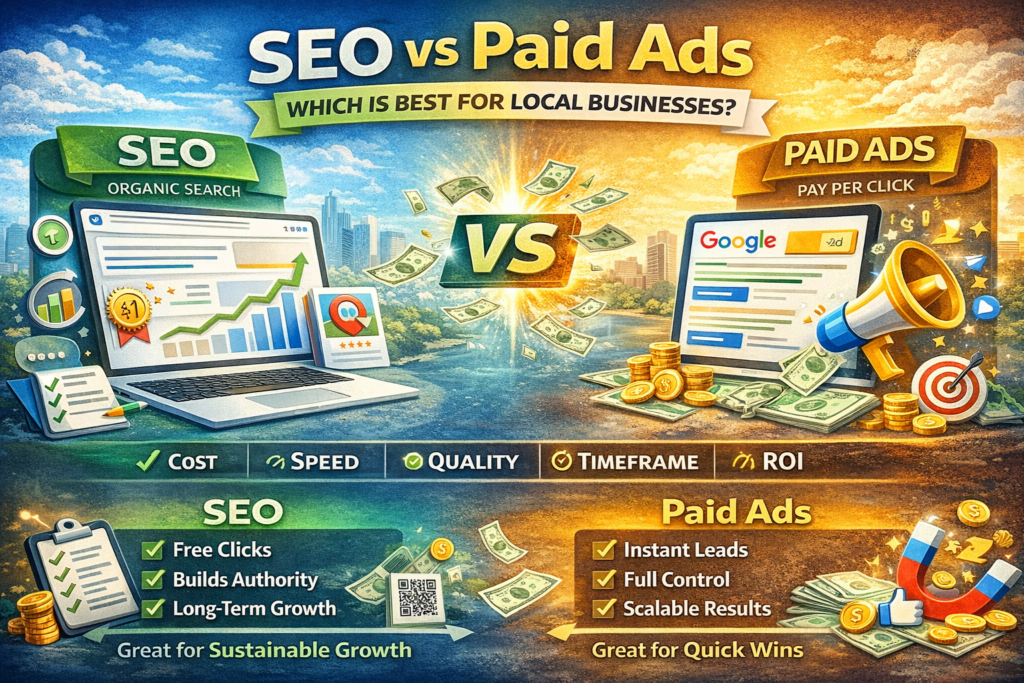
SEO vs paid ads is the biggest marketing decision every local business owner faces. Should you invest in organic rankings that take months to build, or pay for clicks that deliver leads tomorrow? The answer is more nuanced than most agencies will admit.
After helping dozens of Bay Area businesses navigate this exact decision, here are 5 honest truths about SEO vs paid ads that will save you thousands of dollars in wasted spend.
- Truth 1: SEO vs Paid Ads Is the Wrong Question
- Truth 2: The Real Cost of SEO vs Paid Ads Will Surprise You
- Truth 3: Paid Ads Give You SEO Intelligence for Free
- Truth 4: SEO Wins the Long Game Every Single Time
- Truth 5: Your Industry Decides the Right SEO vs Paid Ads Mix
- Smart Budget Allocation Framework
- Frequently Asked Questions
Truth 1: SEO vs Paid Ads Is Actually the Wrong Question
Most business owners frame this as an either/or decision. SEO vs paid ads, pick one. But that framing is flawed.
The businesses that grow fastest use both channels together. Paid ads handle the immediate pipeline. SEO builds the long-term engine that eventually reduces your ad dependence.
According to Google’s research, businesses running both organic and paid search see higher overall click-through rates. Customers trust a business more when it appears in both the ad section and organic results.
So when someone asks “SEO vs paid ads, which is better?” the honest answer is: both, but in different proportions depending on where you are in your growth.
Truth 2: The Real Cost of SEO vs Paid Ads Will Surprise You
Let’s run actual numbers. Take a Bay Area business with a $2,000 monthly marketing budget.
Paid ads scenario: At $15 per click (standard for Bay Area services), you get about 133 website visitors. If 5% convert, that’s roughly 7 leads. Cost per lead: $286. Stop paying, leads stop instantly.
SEO scenario after 6 months: A well-optimized site generates 500+ organic visitors monthly. At 3% conversion, that’s 15 leads. Effective cost per lead: $167. And it keeps dropping.
SEO after 12 months: Traffic grows to 1,000+ visitors. Cost per lead falls below $80. Content from month 3 is still producing leads at zero additional cost.
The SEO vs paid ads math clearly favors organic over time. But only if you can survive the ramp-up period. That’s exactly where paid ads earn their place.
Truth 3: Paid Ads Give You Valuable SEO Intelligence for Free
Here’s a hidden advantage in the SEO vs paid ads debate that few agencies mention. Google Ads shows you exactly which keywords convert, which ad copy resonates, and which landing pages perform.
That data is pure gold for your SEO strategy. Instead of guessing which keywords to target organically, you test them with ads first. You know which terms generate calls, form fills, and real revenue before committing months of SEO work to them.
Smart business owners don’t see SEO vs paid ads as competition between channels. They use ads as a research tool that makes SEO faster and more effective.
Truth 4: SEO Wins the Long Game Every Single Time
Think of SEO like buying commercial property. Paid ads are like renting.
Rent gives you instant access, but you build zero equity. Property costs more upfront but appreciates every year. After 12 months of consistent investment, your organic presence becomes an asset you own.
Research from Ahrefs confirms that top-ranking pages generate traffic for years. A single optimized blog post can deliver leads for 3 to 5 years after publication.
In the SEO vs paid ads comparison, organic search is the compounding investment. Every month of work builds on the last. The same budget produces more leads in month 12 than month 6 because all previous work keeps generating returns.
This compounding effect is the strongest argument for making SEO your primary strategy over time.
Truth 5: Your Industry Decides the Right SEO vs Paid Ads Balance
Not every business should split budget the same way. Here’s how SEO vs paid ads allocation breaks down by industry:
Restaurants and beauty: 80% organic (GBP, reviews, social), 20% paid. Most discovery happens through Maps and review browsing. Ads play a minor role.
Healthcare and dental: 50/50 split. Paid ads capture urgent searches like “emergency dentist near me.” SEO builds the patient pipeline for planned procedures like implants and Invisalign.
Real estate: 70% SEO, 30% paid. Content-heavy strategies like neighborhood guides build agent authority that generates listing appointments for years.
Home services: 40% SEO, 60% paid initially. Emergency searches like “plumber now” need ads. SEO grows over time for planned maintenance searches.
B2B and IT services: 80% SEO, 20% paid. B2B buyers research extensively. Educational content wins deals more effectively than ads.
Smart Budget Allocation Framework for SEO vs Paid Ads
Here’s how to split a $3,000 monthly marketing budget over time:
Months 1 to 3: $1,800 on SEO + $1,200 on ads. SEO builds foundations while ads generate immediate leads.
Months 4 to 6: $2,100 on SEO + $900 on ads. Organic traffic is growing. Ads fill gaps on competitive keywords.
Months 7 and beyond: $2,250 on SEO + $750 on ads. Organic is the primary lead source. Ads handle retargeting and seasonal pushes.
This framework works for most local businesses navigating the SEO vs paid ads decision. Adjust based on your industry using the breakdown above.
Frequently Asked Questions About SEO vs Paid Ads
Which delivers better ROI, SEO vs paid ads?
In months 0 to 3, paid ads usually deliver better immediate returns. After 6 months, SEO almost always wins on ROI and keeps improving. The ideal approach combines both. Read our SEO timeline guide for specific milestones.
How much should a local business spend on digital marketing?
Most small businesses invest $2,000 to $5,000 per month across all channels. Your ideal budget depends on competition, customer lifetime value, and growth goals. See real examples in our case studies.
Can I run SEO and Google Ads at the same time?
Yes. We strongly recommend it. Data from your ad campaigns directly improves your SEO targeting. The two channels make each other more effective.
When can I stop paying for ads and rely only on SEO?
Most businesses never fully stop paid ads. Instead, they reduce spend as organic traffic grows. The ad budget shifts to retargeting, seasonal campaigns, and testing new keyword opportunities.
What if I only have $1,000 per month to spend?
At that budget, we recommend starting with GBP optimization and review generation (organic) plus a small $300 to $500 Google Ads campaign targeting your highest-value keywords. This gives you both long-term SEO benefit and immediate lead flow.
Not sure whether SEO, paid ads, or a combination is right for your business? Book a free audit call and we’ll analyze your market and recommend the exact budget split for your industry.